
Greenlee County Criminal Docket Searches
Begin with the Arizona Judicial Branch Public Access to Court Information site. It is free and covers participating courts statewide. Expect a random-word check on the first screen. Once past it, enter an exact case number if you have one. A name search works as the fallback. Narrowing the court or county to Greenlee helps when that option appears. Open the full case history too, since the result-list status can lag behind the record. A strong search pairs the defendant name as filed with the court name. Add any case number from a notice or citation. Remember that Public Access is a lead, not the official record. It updates weekly, and Friday data generally reflects filings through Wednesday. For a current setting, warrant, bond term, or release condition, call the assigned court that same day.
- Identify Superior Court, JP1, JP2, or Clifton Municipal Court from the papers.
- Pass the Public Access verification and search the exact number or filed name.
- Open the matching Greenlee case and check court, charges, and newest event.
- Compare each future setting with later reset, vacated, or minute-entry events.
- Request the needed docket, order, or certified disposition from its court clerk.
Some Superior Court criminal documents qualify for eAccess. The cutoff is filings made on or after July 1, 2010. An account registration comes first. Justice and Municipal Court documents fall outside that stated coverage. For a misdemeanor copy, go to the limited court that created the case.
Greenlee Criminal Dockets Split Courts
Venue splits cleanly in this county. The Greenlee County Attorney explains the basic venue split: Superior Court tries felonies, while Justice Court handles county misdemeanors. Clifton Municipal Court hears Clifton ordinance cases. It also takes eligible state misdemeanor and traffic matters inside town limits. One wrinkle matters for docket hunters. A felony can start with an initial proceeding in a limited court. A separate Superior Court prosecution is filed after that.
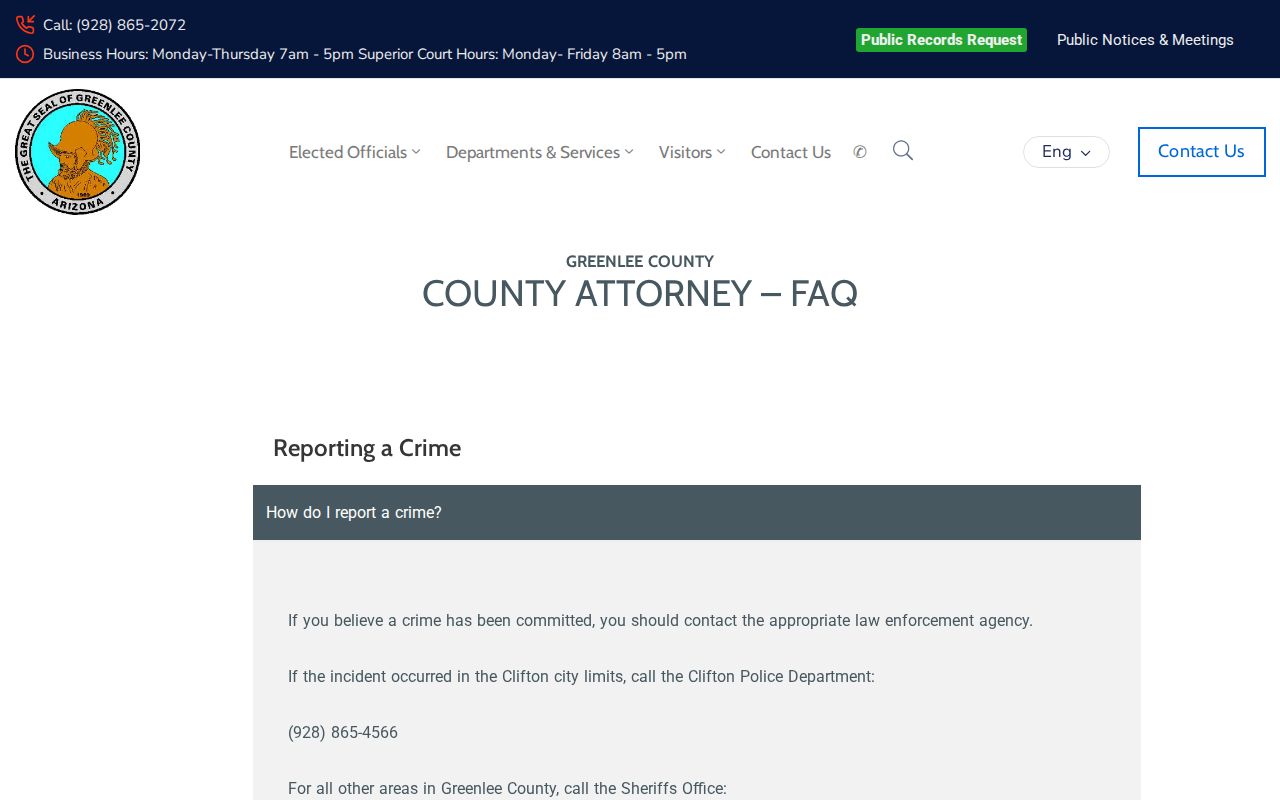
That split makes the court name a core search key. Calling the Greenlee County Clerk of the Superior Court about every criminal file can miss records. JP1, JP2, and Clifton Municipal keep their own dockets, so ask the court that actually holds the case.
| Court | Criminal docket role | Record contact |
|---|---|---|
| Greenlee Superior Court | Felonies and authorized lower-court appeals | Clerk, 928-865-4242 |
| JP1 / Clifton Justice | County misdemeanors and early felony work in its precinct | 928-865-4312 |
| JP2 / Duncan Justice | The same limited classes in its precinct | 928-359-2536 |
| Clifton Municipal Court | Town ordinances and eligible state-law matters | 928-865-4156 |
Criminal Dockets: What They Show
A Greenlee County criminal docket is an index of essentials. It typically lists the case number, court, filing date, status, parties, counsel, judicial officer, charges, scheduled events, and disposition. Treat the event history as an index. A line reading "Motion filed" proves only that a request entered the case history. It never means the judge granted it. The same caution applies to charges. A charge stays an allegation until a later plea or adjudication resolves it.
| Case number | The exact court identifier. Preserve its punctuation and do not invent a sample format. |
|---|---|
| Charge counts | Each count can carry its own statute, classification, plea, and outcome. |
| Events | Complaint, initial appearance, motions, minute entries, pleas, and appeal notices in date order. |
| Settings | Arraignment, pretrial, trial, change-of-plea, sentencing, or review dates. |
| Disposition | The recorded result by count, which may differ across one case. |
Read each charge on its own. One dismissed count leaves the others standing, and a conviction on one count does not resolve the rest. When exact wording matters, pull the linked or named order, minute entry, or judgment instead of trusting a short event label.
Greenlee Docket Events and Documents
Public Access and eAccess do different jobs. Public Access gives free statewide case information plus the chronological history. The Arizona eAccess overview covers paid access to eligible Superior Court documents. Those are civil and criminal filings made on or after July 1, 2010. Registration is required, and offered images can carry per-document or subscription charges. Electronic certification costs extra, and the current amount must be confirmed at purchase. A line in the Greenlee County criminal docket does not promise a matching image. A minute entry or motion may be indexed yet unavailable online. That happens because it sits outside eAccess coverage, is restricted, predates the cutoff, or belongs to a limited court. The court clerk remains the fallback for inspection and copies. Public Access itself sends document seekers to eAccess. Neither tool replaces the custodian's official file.
Two layers: Use Greenlee case history to identify the precise event title and date. Then seek the document through eAccess or the creating court.
Note: Payment portals collect case-linked funds only. They do not serve as Greenlee County criminal docket databases or official case histories.
Criminal Case Stages on the Docket
A Greenlee criminal case can open with a complaint, arrest, or citation. The docket may then show an initial appearance and release terms. Felony matters can pass through a preliminary hearing or grand jury. An information or indictment arrives after that. Arraignment addresses the charge and the plea. Disclosure, motions, and pretrial settings follow. Then a plea or trial resolves the charge, with sentencing recording the penalty after conviction.
Docket flow: Complaint or Citation › Initial Appearance › Arraignment › Pretrial › Plea or Trial › Disposition › Sentencing
Not every Greenlee case uses each stage. A dismissal can end things before trial. Probation review, restitution, appeal, or post-judgment activity may add later events. A motion to continue is only a request. It stays that way until the court signs or enters an order. Old and new settings may both appear in the history. The newest signed order or clerk-confirmed setting controls.
Empty Greenlee Criminal Docket Results
A blank statewide result does not mean the Greenlee County criminal docket is missing. The search may have the wrong spelling, no exact case number, or the wrong court. It can also lag behind a fresh filing. Public Access leaves out local ordinance charges and sealed cases. Orders of Protection, mental-health matters, victim and witness data, and specified juvenile matters are excluded too.
Run the exact case number plus a few name spellings. Then call the court itself. Felonies sit with the Superior Court clerk. Misdemeanors go to JP1 or JP2, and town charges to Clifton Municipal Court. Ask staff to confirm the case number, its status, and the next setting. Also ask about the inspection route and the copy charge. Ask whether an older record is paper or archived. Staff cannot disclose protected facts.
Need a hearing this week? Trust filed notice, a signed minute entry, or word straight from the court. The portal updates weekly, so it is too slow for a same-day decision.
Greenlee County Criminal Docket Courts
Criminal dockets in Greenlee County live in more than one office. The Greenlee County Clerk of the Superior Court keeps the Superior Court criminal docket. Each Justice Court keeps its own misdemeanor record. Clifton Municipal Court keeps the matters it created. The clerk's published copy schedule lists "Copies" at $0.50, "Certified copies" at $30, "Search" at $30, and postage/handling at $7. Repeat those short labels as written when you ask. They set no per-page unit or application rule. The statute behind clerk access and fees is A.R.S. §12-119.01.
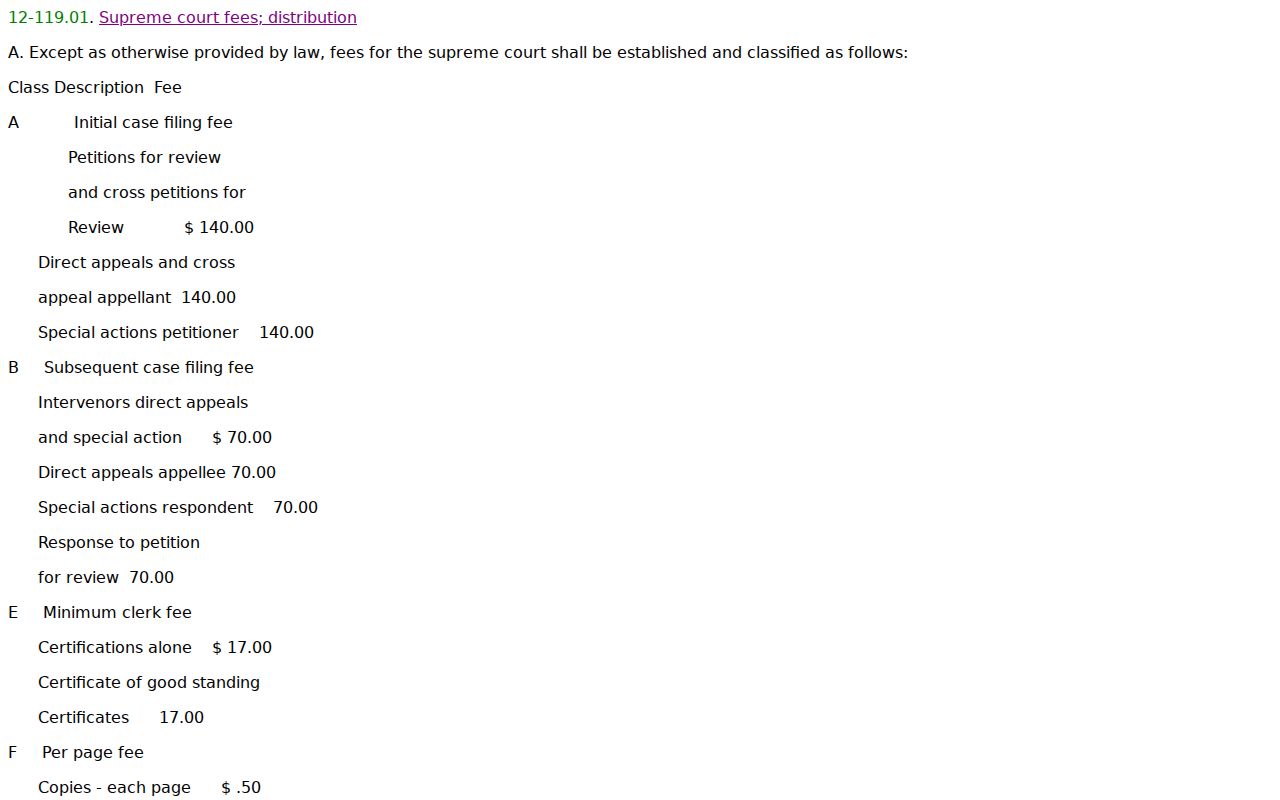
That fee schedule covers the Superior Court clerk alone. It does not cover every Justice or Municipal charge in Greenlee County. Get a fresh quote from the limited court that made the record. A certified disposition should name the exact case and document. It should state whether certification is needed. It should also confirm delivery and accepted payment with that office.
Greenlee Criminal Docket Reset Checks
A hearing can stay on the calendar after a case moves. So read past the first date. Scan the docket for "continued," "reset," or "vacated." Also look for a later notice of hearing or a signed minute entry. Bond, warrant, and release entries deserve the same check. Any of them can change after the portal's last weekly update.
If the status affects an appearance today, call the assigned Greenlee court. Give the case number. Ask whether the setting stands and where it will happen. Ask whether the mode is in person, by telephone, or remote. The electronic-hearing directory is only a contact list, not a hearing-date calendar. The court itself must supply access details for a remote proceeding.
Time-sensitive record: Never rely on a Friday-to-Wednesday statewide data cycle for a same-day warrant, release term, or court appearance.
Greenlee Criminal Docket Sealing
Sealing in Arizona is not deletion. A.R.S. §13-911 sets out a petition process for qualifying criminal case records, limited by eligibility rules and exceptions.
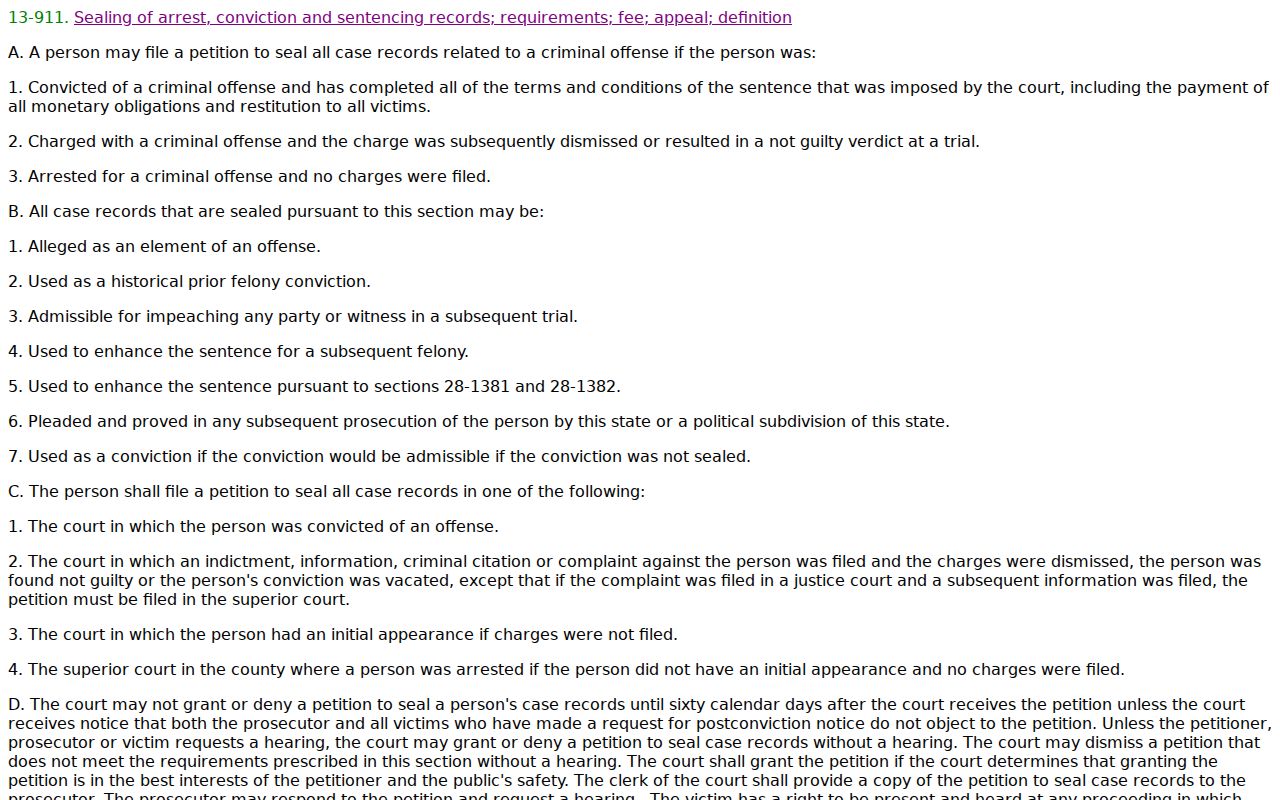
A sealed Greenlee County criminal docket can drop from ordinary public display, yet courts and justice agencies may still reach it as law permits. Redaction works differently. The case history stays public while protected identifiers or images stay hidden. Note that "dismissed" does not mean sealed or expunged. A separate remedy appears in A.R.S. §13-4051 for certain wrongful arrest, indictment, or charge circumstances.
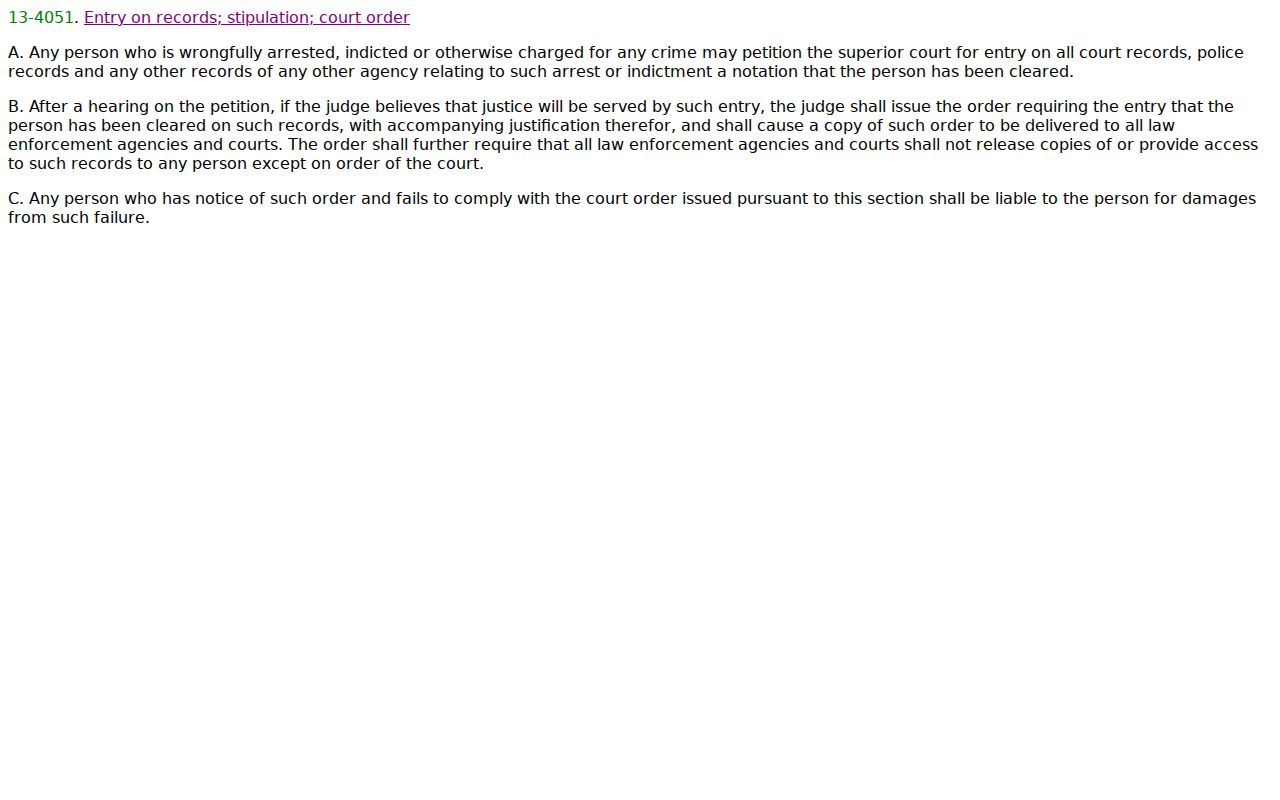
That statute grants specific court relief. It does not let a reader rewrite a docket entry. Nor can anyone assume relief was granted without the court's order.
Access Rules for Criminal Dockets
Arizona Supreme Court Rule 123 sets the ground rules for judicial records in every Arizona court, from Superior to Justice to Municipal. It spells out the difference between case records and administrative records, names who keeps them, and limits what can be seen from afar. So a Greenlee County criminal docket you pull up online may show less than what the clerk could hand you at the courthouse counter.
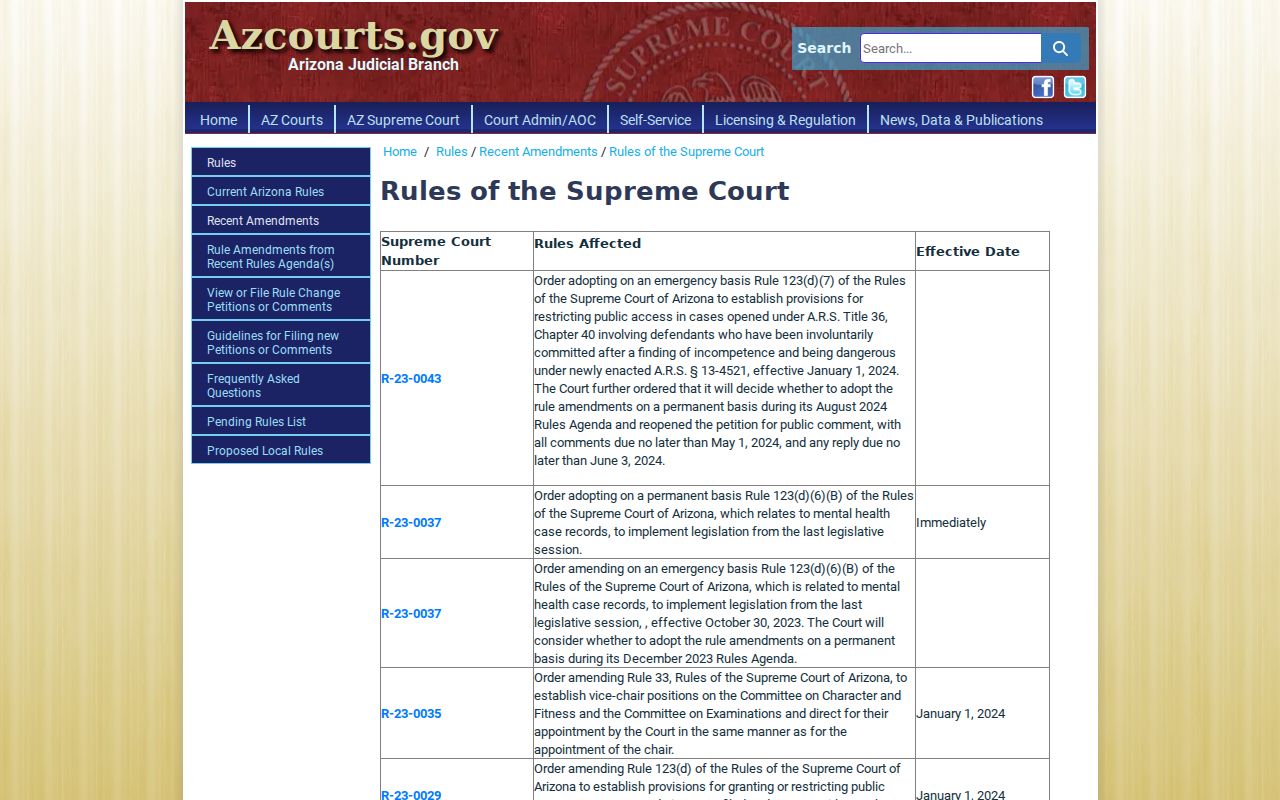
Confidentiality rules shift over time. The Arizona Supreme Court amendments index lists each recent change, so you can see the current wording of any rule that affects access to court records.
Check the official rule whenever remote display shifts. For a Rule 123 request, name the court and custodian. Give the exact case number, record title, date range, and format. Ask for a fee estimate. If access is denied, request the legal basis. Then use the rule's own review process to challenge the denial.
Key rules:
Arizona Supreme Court Rule 123 supplies the judicial-record access and review framework.
A.R.S. §13-911 creates petition-based sealing for qualifying criminal records.
A.R.S. §13-4051 addresses specified wrongful arrest or charge notation relief.